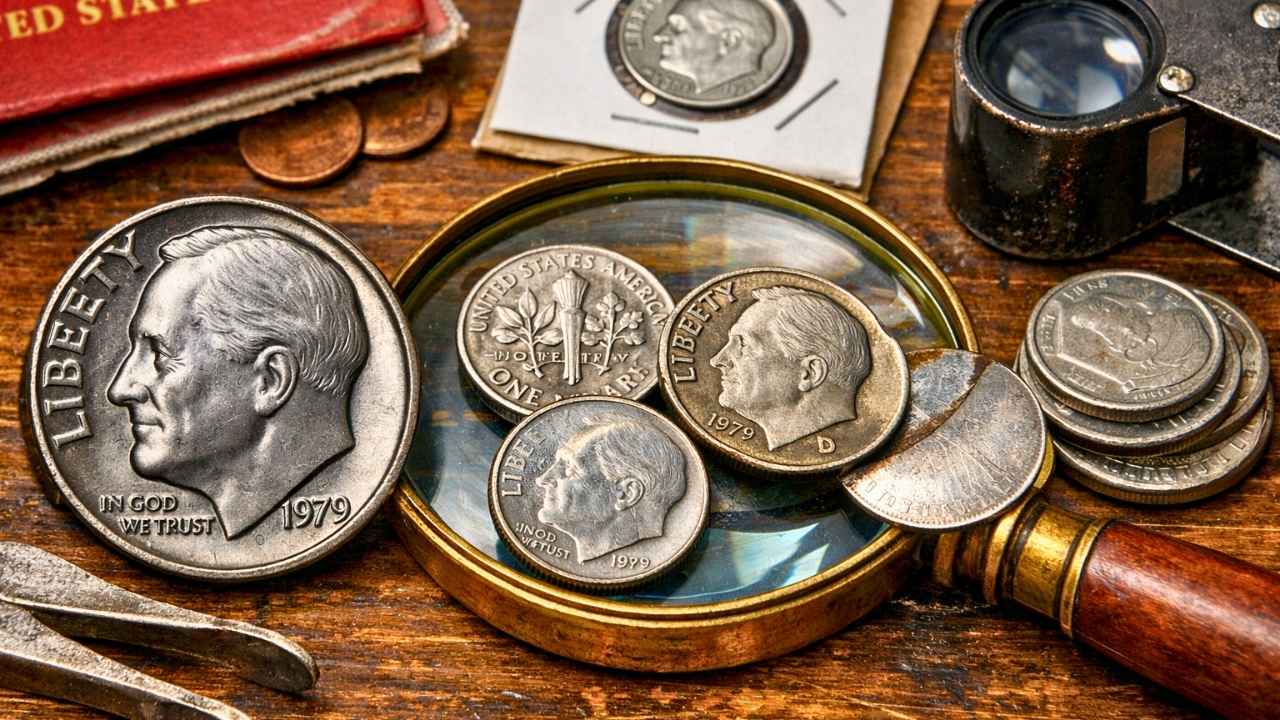
1979 Dime Value Guide: Most people never give a second thought to a dime. It is small, common, and easy to ignore in everyday pocket change. Yet the 1979 Roosevelt dime continues to attract attention from collectors and curious coin hunters who wonder if a simple ten-cent piece could be hiding unexpected value. While 1979 dimes are not generally rare, certain mint marks, conditions, and error varieties can make some examples far more interesting than their face value suggests. Knowing what to look for can turn a routine glance at loose change into a small but satisfying discovery.
A Quick Look at the 1979 Roosevelt Dime
The Roosevelt dime has been part of U.S. coinage since 1946, honoring President Franklin D. Roosevelt. By 1979, the design was familiar to Americans, with Roosevelt’s profile on the front and a torch flanked by olive and oak branches on the reverse. These dimes were struck in a copper-nickel clad composition rather than silver, which means most 1979 dimes are not valuable for metal content. Their value comes from condition, collector demand, and the presence of unusual errors.
Mint Marks and What They Mean for Value
In 1979, dimes were produced at three different mints. Philadelphia struck coins without a mint mark. Denver coins carry a small D. San Francisco produced proof dimes with an S mint mark, primarily intended for collectors.
Philadelphia and Denver dimes were made in large quantities for circulation, so most examples found today are very common. San Francisco proof dimes were made in smaller numbers and were never meant for everyday use. Because of this, proof dimes in original condition tend to have higher value, especially when they still show deep mirrored fields and sharp details.

Mint marks alone do not make a 1979 dime rare, but they do help identify what type of coin you have and what kind of value range you should expect. A worn Philadelphia or Denver dime is typically worth only face value, while a pristine proof from San Francisco can be worth several dollars to collectors.
Condition and Grading: Why Quality Matters
The condition of a coin plays a major role in determining its worth. Collectors use grading scales to describe how well a coin has been preserved. A 1979 dime that has spent decades in circulation will show scratches, dullness, and worn details. These coins are plentiful and usually have no premium value.
On the other hand, dimes that were carefully saved or never circulated can appear almost new, with bright surfaces and crisp design elements. High-grade examples can sell for more, even if the coin itself is common. The difference between a lightly worn dime and a near-perfect one can be surprisingly large in terms of collector interest.
If you believe you have a particularly sharp or well-preserved 1979 dime, it may be worth comparing it to grading guides or having it evaluated by a professional coin dealer.

Rare Errors That Can Add Value
Error coins are where things get interesting. These are coins that left the mint with some kind of mistake during production. Not every error is valuable, but certain types can attract collectors who specialize in unusual or flawed pieces.
Common errors on dimes include off-center strikes, where the design is not properly aligned, and clipped planchets, where a portion of the metal blank is missing. Another category includes die cracks or cud errors, where parts of the die were damaged and left raised lines or blobs on the finished coin.
A more subtle error can be a doubled die, where parts of the design appear slightly doubled due to a misalignment during the die creation process. These can be harder to spot and often require magnification. The more dramatic and clearly visible the error, the more likely it is to draw interest from collectors.
How Much Is a 1979 Dime Really Worth
For most people, the honest answer is that a 1979 dime found in everyday change is worth ten cents. Millions were minted, and the vast majority have no special features. However, there are a few scenarios where value increases.
Uncirculated examples can be worth a small premium, especially if they have been stored carefully and show no signs of wear. Proof dimes from San Francisco typically sell for a few dollars, depending on their condition and packaging.
Error coins can range widely in value. Minor errors might bring a small premium, while more dramatic or visually striking errors can sell for significantly more. The market for error coins is niche, and prices depend heavily on collector demand and the uniqueness of the flaw.
How to Check Your Coin at Home
Examining your dime does not require special equipment to start. Good lighting and a simple magnifying glass can reveal a lot. Look closely at the edges, the lettering, and the details of Roosevelt’s face. Compare your coin to images of normal 1979 dimes to see if anything looks out of place.
Pay attention to the mint mark, if any, and note whether the surfaces look proof-like with mirror finishes or more like standard circulation coins. If you think you have found an error, take clear photos and compare them with examples from reputable coin references or collector forums.
Where to Sell or Get an Appraisal
If you believe your 1979 dime might have value beyond face value, a local coin shop is often the easiest place to start. Experienced dealers can quickly tell you whether your coin is common or worth further attention. Coin shows and online marketplaces also provide opportunities to compare prices and see what similar coins are selling for.
For potentially valuable coins, professional grading services can provide authentication and an official grade, which can make selling easier. However, grading costs money, so it is usually only worth considering if the coin appears to be in exceptional condition or has a clear and desirable error.

Final Thoughts for Casual Collectors
The 1979 dime is a reminder that not every coin in circulation is a hidden treasure, but some can still be interesting to explore. Learning to recognize mint marks, condition differences, and basic errors can add a new layer of enjoyment to handling everyday change. Even when the value is modest, the process of looking closely at coins can connect you to a small piece of history and craftsmanship that often goes unnoticed.
Checking your pocket change may not make you rich, but it can turn an ordinary moment into a small discovery. Over time, that curiosity is often what leads people deeper into the world of coin collecting, where even the most common coins have stories to tell.