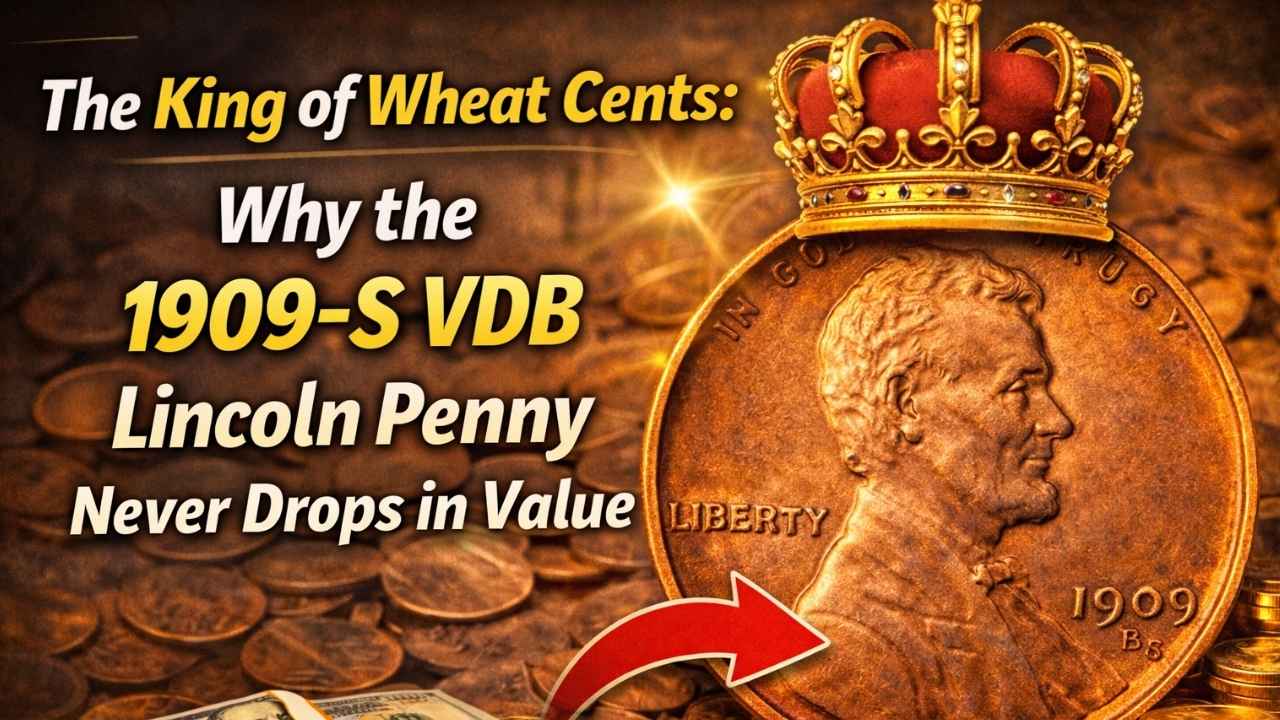
The King of Wheat Cents: In 1909, the United States Mint introduced a new one-cent coin to honor the 100th anniversary of Abraham Lincoln’s birth.
It was the first time a real historical figure appeared on a regular U.S. circulating coin. Designed by Victor David Brenner, the Lincoln cent marked a bold departure from earlier symbolic designs featuring Lady Liberty.

Collectors were immediately intrigued.
But no one could have predicted that one small detail on that first year of issue would create the most famous wheat cent of all time.
The Controversy Behind the VDB Initials
When the Lincoln cent debuted in 1909, Brenner placed his initials, VDB, prominently on the reverse at the bottom between the wheat stalks.
While artists traditionally sign their work, the placement of these initials stirred controversy. Critics argued that the lettering was too large and too noticeable.
Public debate escalated quickly.
Within months, the Mint removed the initials from the reverse design. Production continued without them.
That decision created an instant rarity.
Why the 1909-S VDB Is So Special
Two factors make the 1909-S VDB Lincoln penny legendary.
First, it was struck at the San Francisco Mint, as indicated by the small S mint mark below the date.
Second, it carried the now-removed VDB initials on the reverse.
Only 484,000 coins were produced before the initials were eliminated.
Compared to the millions of Lincoln cents struck in later years, this was a remarkably low mintage. From the very beginning, collectors recognized its significance.
The coin became a key date overnight.
Scarcity That Stands the Test of Time
Many coins rise in value because they are rare in high grades but common overall.
The 1909-S VDB is scarce at every level.
Even well-worn examples command strong prices. In better condition, values climb significantly. Uncirculated specimens, especially those with rich original red color, can bring substantial premiums at auction.
The consistent demand is what truly sets this coin apart.
Collectors building a complete Lincoln wheat cent set cannot avoid it. It is the cornerstone of the entire series.
Without it, the set feels incomplete.
The Power of Being First
Part of the coin’s enduring strength lies in its timing.
It represents the very first year of the Lincoln cent series.
Collectors place enormous importance on first-year issues. They symbolize beginnings. They mark transitions in design and history.
The 1909-S VDB captures that sense of origin.
It is not just a scarce penny.
It is the starting point of more than a century of continuous Lincoln cent production.
A Perfect Combination of Story and Rarity
Coins with strong backstories tend to attract lasting interest.
The 1909-S VDB has everything.
It was part of a major design change.
It sparked public controversy.
Its defining feature was removed almost immediately.
Its mintage was limited.
It quickly became recognized as special.
That blend of history and scarcity gives it depth beyond simple numbers.
Collectors are not just buying metal.
They are buying a moment in American numismatic history.
Demand That Never Weakens
One reason the 1909-S VDB never drops significantly in value is steady demand across generations.
New collectors entering the hobby often begin with Lincoln cents. They are affordable, widely available, and easy to understand.
As those collectors advance, they inevitably learn about the 1909-S VDB.
It becomes a goal.
Because the Lincoln cent series remains popular year after year, the pool of potential buyers never disappears.
Even during broader economic downturns, interest in this coin tends to remain stable.
Condition and Color Matter
Not all 1909-S VDB cents are equal.
Copper coins change color over time. Some turn brown. Others retain partial red luster. The rarest and most valuable examples are classified as full red, meaning they preserve much of their original mint color.
High-grade red examples are especially coveted.
Small differences in preservation can mean large differences in price.
This range of conditions creates a layered market. Some collectors aim for an affordable circulated piece. Others compete fiercely for top-tier specimens.
That competition supports long-term value.
Counterfeits and the Importance of Authentication
Because the coin is so valuable, it has been widely counterfeited.
Some altered coins involve adding an S mint mark to a common 1909 VDB cent. Others attempt to add VDB initials to a 1909-S without them.
For this reason, authentication by reputable grading services is essential before purchasing one.
The need for verification adds another layer of seriousness to owning the coin.
Collectors approach it with respect.
A Symbol of the Wheat Cent Era
The Lincoln wheat cent design remained in production until 1958.
Over those decades, many key dates emerged. Yet none achieved the same legendary status as the 1909-S VDB.
It is often referred to as the king of wheat cents.
That title reflects more than just price.
It reflects recognition.
Among collectors, mentioning the 1909-S VDB immediately signals importance.
A Long-Term Store of Value
While no investment is guaranteed, the 1909-S VDB has demonstrated remarkable resilience.
Over decades, it has consistently appreciated in value. Temporary fluctuations may occur, but the overall trend has been steady.
Its rarity is fixed.
Its historical importance cannot be erased.
Its place in the Lincoln series is secure.
Those factors combine to create lasting confidence in the coin’s desirability.
More Than Just a Penny
At first glance, it is a small copper coin worth one cent.
But its story elevates it far beyond face value.
It represents artistic controversy.
It marks the birth of a new design era.
It embodies scarcity from the moment of release.
And it continues to captivate collectors more than a century later.
That is why the 1909-S VDB Lincoln penny remains the undisputed king of wheat cents.