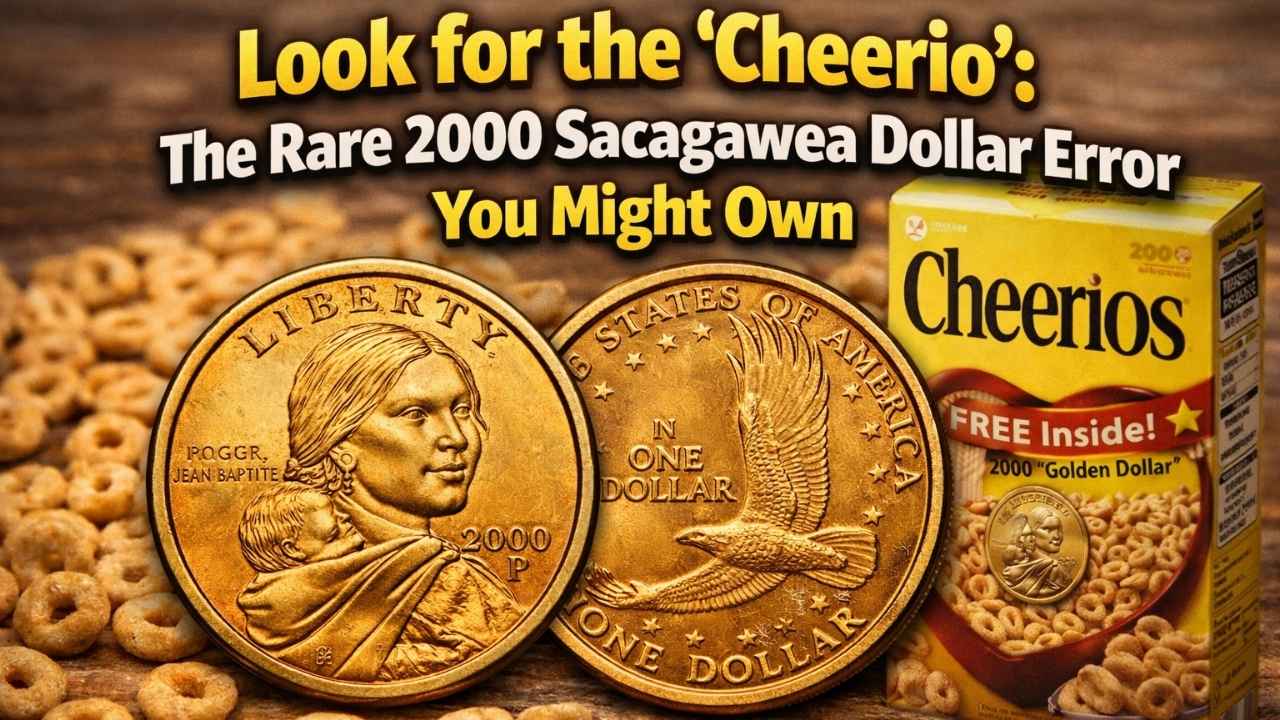
Look for the “Cheerio: In early 2000, as the United States introduced a brand-new dollar coin honoring Sacagawea, few people imagined that one of the rarest modern coin varieties would be discovered inside cereal boxes. What seemed like a simple marketing promotion would later spark intense excitement among collectors.
The so-called “Cheerios” Sacagawea Dollar has since become one of the most talked-about modern coin varieties. Unlike classic rarities from the early 1900s, this coin is relatively recent. That makes the possibility of owning one feel surprisingly real.

If you have a 2000 Sacagawea Dollar tucked away in a drawer, it may be worth taking a closer look.
The Launch of the Sacagawea Dollar
The Sacagawea Dollar was introduced in 2000 to replace the unpopular Susan B. Anthony dollar. The new coin featured a golden color, achieved through a manganese-brass alloy, and a powerful obverse portrait of Sacagawea carrying her infant son.

The reverse design, created by artist Thomas D. Rogers, depicts a soaring eagle surrounded by stars. The coin was meant to feel fresh and inspiring, a modern tribute to American history.
To promote the new dollar coin and encourage public interest, the U.S. Mint partnered with General Mills. As part of the campaign, specially packaged 2000 Sacagawea Dollars were placed inside boxes of Cheerios cereal before the coin was officially released into circulation.

This is where the story takes an unexpected turn.
What Makes the “Cheerios” Dollar Different
Approximately 5,500 Sacagawea Dollars were distributed through the Cheerios promotion. For years, they were believed to be identical to regular 2000-dated coins struck at the Philadelphia Mint.

However, collectors eventually noticed something unusual.
The reverse design on some of these promotional coins showed enhanced detail in the eagle’s tail feathers. The lines were sharper and more defined than on standard circulation strikes. This detail was part of an earlier design variation that was changed before full production began.
In other words, the coins placed inside cereal boxes featured a prototype reverse that never made it into widespread circulation.
That subtle difference transformed an ordinary-looking dollar into a modern rarity.
How Rare Is the Cheerios Sacagawea Dollar
Although 5,500 coins were included in the promotion, not all of them have been confirmed as the rare enhanced tail feather variety. Over time, only a fraction have been identified and certified by major grading services as true “Cheerios” dollars.
Many of the original recipients likely spent the coin, lost it, or stored it away without realizing its significance. Others may still sit in old collections, unnoticed and unexamined.

Compared to millions of standard 2000 Sacagawea Dollars produced, the enhanced tail feather version is exceptionally scarce. That scarcity is what drives collector demand.
Value and Market Interest
The value of a Cheerios Sacagawea Dollar depends heavily on condition. Coins that remain in original packaging and exhibit minimal wear command the highest prices.
Certified high-grade examples have sold for thousands of dollars at auction. Even circulated specimens, if authenticated, can bring substantial premiums over face value.
Unlike legendary early 20th century coins that cost millions, this is a modern variety that feels attainable. Its price range makes it accessible to serious collectors while still offering significant upside for those lucky enough to own one.
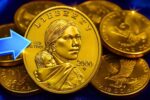
The combination of rarity, a fascinating backstory, and modern origin makes it especially appealing.
How to Identify One in Your Collection
If you own a 2000 Sacagawea Dollar, the first step is to examine the reverse carefully. Focus on the eagle’s tail feathers.

On the enhanced version, the tail feathers show distinct central lines and sharper separation between feather segments. The detailing appears more intricate compared to the flatter look of regular circulation coins.
Because the difference can be subtle to the untrained eye, serious collectors often compare high-resolution images or consult grading services for confirmation. Authentication is essential, as value depends entirely on verifying the enhanced tail feather design.
If you still have original Cheerios packaging from 2000, that adds historical interest. However, the key factor remains the reverse design detail.
Why This Coin Captivates Modern Collectors
The Cheerios Sacagawea Dollar represents something unique in American coin collecting. It is not ancient, not tied to wartime shortages, and not the result of a dramatic minting accident.
Instead, it emerged from a promotional campaign and a minor design revision. Its rarity was discovered years after release, adding an element of surprise and detective work.
Modern collectors appreciate that this variety shows how even recent coins can hold hidden secrets. It challenges the assumption that only old coins can be valuable.
It also reminds collectors to pay attention to small design changes, as those details often separate common coins from rare treasures.
The Thrill of Checking Your Own Coins
One of the most exciting aspects of the Cheerios Sacagawea Dollar is the possibility that someone, somewhere, still owns one without knowing it.
Unlike ultra-rare coins locked away in museum collections, this variety entered households across America in cereal boxes. It may still sit in a forgotten jar of change, an old childhood coin folder, or a small keepsake box.
That possibility fuels ongoing interest. Every time someone examines a 2000 Sacagawea Dollar, there is a small spark of hope.
A Modern Classic in the Making
More than two decades after its release, the Cheerios Sacagawea Dollar has secured its place among notable modern U.S. coin varieties. It bridges the gap between traditional numismatics and contemporary collecting.
As time passes and fewer examples remain in top condition, its status is likely to strengthen. Collectors continue to search for authenticated specimens, and each discovery renews excitement.
The next time you come across a 2000 Sacagawea Dollar, do not dismiss it as ordinary pocket change. Look closely at the eagle’s tail feathers.
You might just be holding one of the most fascinating modern coin discoveries of the 21st century.