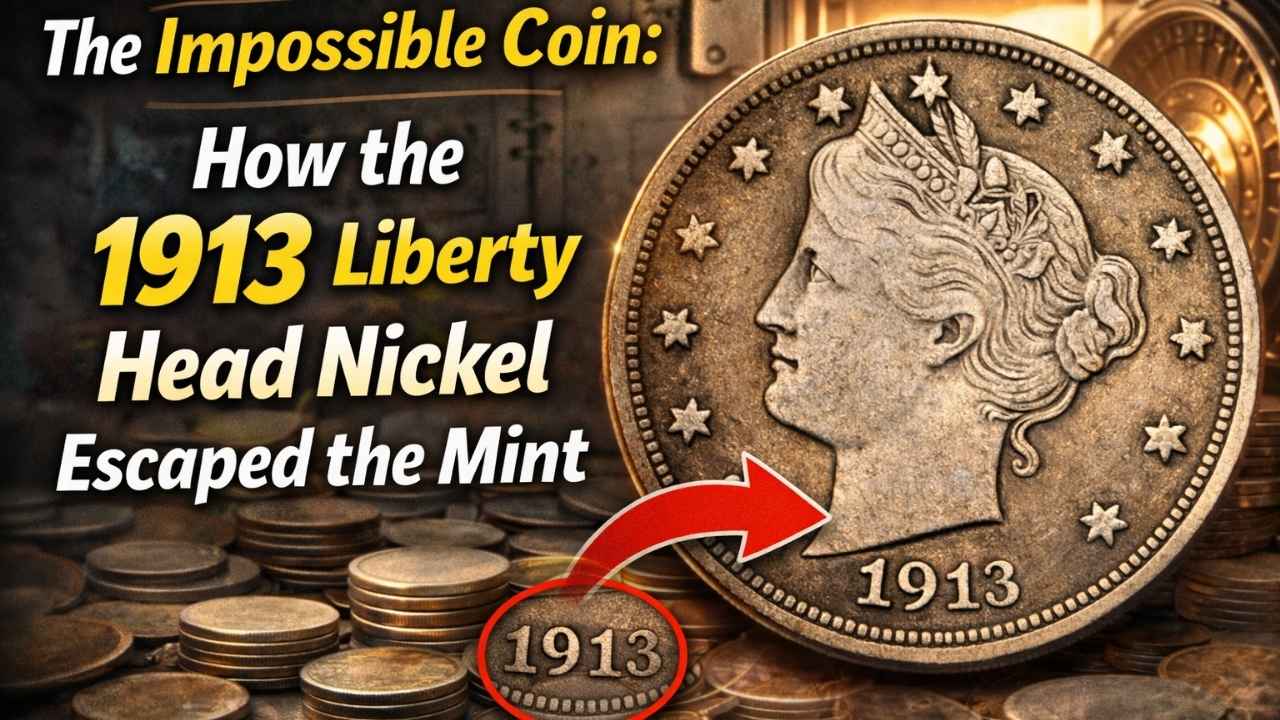
The Impossible Coin: Some coins are rare because they were struck in small numbers.
Others are rare because time erased them.

The 1913 Liberty Head Nickel is rare for a far stranger reason. It was never officially authorized for production at all.
Yet five examples exist.
They are real. They are authenticated. They have crossed auction blocks for millions of dollars. And they remain one of the most mysterious creations in American numismatic history.
The story of how this “impossible coin” escaped the Mint continues to fascinate collectors more than a century later.
The End of the Liberty Head Design
The Liberty Head Nickel, also known as the V Nickel, was introduced in 1883. Designed by Charles E. Barber, it featured a classical portrait of Liberty on the obverse and a large Roman numeral V on the reverse to indicate five cents.
By 1912, the design was nearing the end of its run. The United States Mint had already prepared to replace it with a new design featuring a Native American portrait on the front and a buffalo on the back. That coin would become known as the Buffalo Nickel.

Official records show that Liberty Head Nickels were struck through 1912.
No production was authorized for 1913.
On paper, the 1913 Liberty Head Nickel should not exist.
The Shocking Discovery
In 1920, a former Mint employee named Samuel Brown quietly displayed five 1913 Liberty Head Nickels at a coin convention.
Collectors were stunned.
There had been no announcement of their existence. No official record. No explanation.
Brown claimed to have owned the coins for years, though many suspected he may have acquired them during his time working at the Mint.
Whether the coins were struck secretly as unauthorized pieces or created as presentation specimens remains unclear. The Mint itself never officially documented their production.
That unanswered question is part of the coin’s enduring mystery.
Only Five in the World
Unlike many rare coins with uncertain survival numbers, the 1913 Liberty Head Nickel is precise in its population.
There are only five known examples.
Each one has been carefully tracked for decades. Each has its own nickname, ownership history, and story.
They are often referred to by the names of famous collectors who once owned them, including the Eliasberg specimen and the Olsen specimen.
The tiny number gives the coin a near-mythical status. When one appears at auction, it becomes a global event within the collecting community.
A Star Beyond the Hobby
The fame of the 1913 Liberty Head Nickel extends far beyond traditional coin circles.
One of the five specimens was owned by King Farouk of Egypt. Another appeared on a television show in the 1970s, bringing the coin into mainstream attention.
Over the decades, these nickels have sold for increasingly dramatic sums. Prices have climbed from thousands to hundreds of thousands, and eventually into the millions.
Today, they are valued as some of the most important coins in American history.
Their reputation has made them cultural icons, not just collectible objects.
Theories About Its Creation
How did these coins come into existence?
There are several theories.
One suggests that Samuel Brown struck them secretly before the dies were destroyed, possibly as experimental or souvenir pieces. Another theory proposes that they were produced as presentation coins but never officially recorded.
The truth may never be known.
What makes the mystery compelling is that the Mint was transitioning from the Liberty design to the Buffalo Nickel at the time. Dies for the old design may still have been accessible. A small, unauthorized run could have occurred without formal approval.
If that is what happened, the 1913 Liberty Head Nickel represents one of the most daring acts in Mint history.
The Power of Forbidden Rarity
Collectors are drawn to rarity.
But forbidden rarity carries a different kind of appeal.
This coin was not meant to exist. It was not part of a regular issue. It was not sold in sets. It slipped into the world quietly, almost defiantly.
That narrative adds depth to its value.
Owning one of the five examples is not just about possessing a rare nickel. It is about holding a piece of unanswered history.
Each Coin Has Its Own Story
The five known specimens are not identical in condition.
Some are sharper, with stronger details. Others show more wear. One example was discovered decades later in a closet after being stored in a simple envelope.
These individual stories add personality to each coin. They are not just five identical objects. They are five survivors, each with its own journey.
Collectors study their pedigrees as carefully as their surfaces.
Why It Captures the Imagination
The 1913 Liberty Head Nickel appeals to something deeper than financial value.
It represents secrecy.
It represents defiance.
It represents the idea that even in a tightly regulated system like the United States Mint, something extraordinary can slip through.
There is a sense of drama in its existence. It feels like a historical accident wrapped in intrigue.
For collectors, that combination is irresistible.
A Benchmark for American Rarities
In the world of United States coin collecting, a handful of coins define greatness.
The 1913 Liberty Head Nickel sits comfortably among them.
It is frequently compared to other legendary rarities. It appears in major auctions as a headline attraction. It is discussed in books, documentaries, and exhibitions.
Its existence challenges assumptions about minting records and official documentation.
It proves that even well-documented systems can hold secrets.
The Legacy of the Impossible Coin
More than a century after 1913, the Liberty Head Nickel from that year continues to spark debate.
No new examples have surfaced. The count remains at five.
Each time one changes hands, it reminds the collecting world that mystery still has power.
The 1913 Liberty Head Nickel is not simply a rare coin.
It is a story.
It is a puzzle.
It is a reminder that history sometimes leaves room for questions without answers.
And perhaps that is why it remains one of the most fascinating coins ever struck, even if it was never supposed to be struck at all.