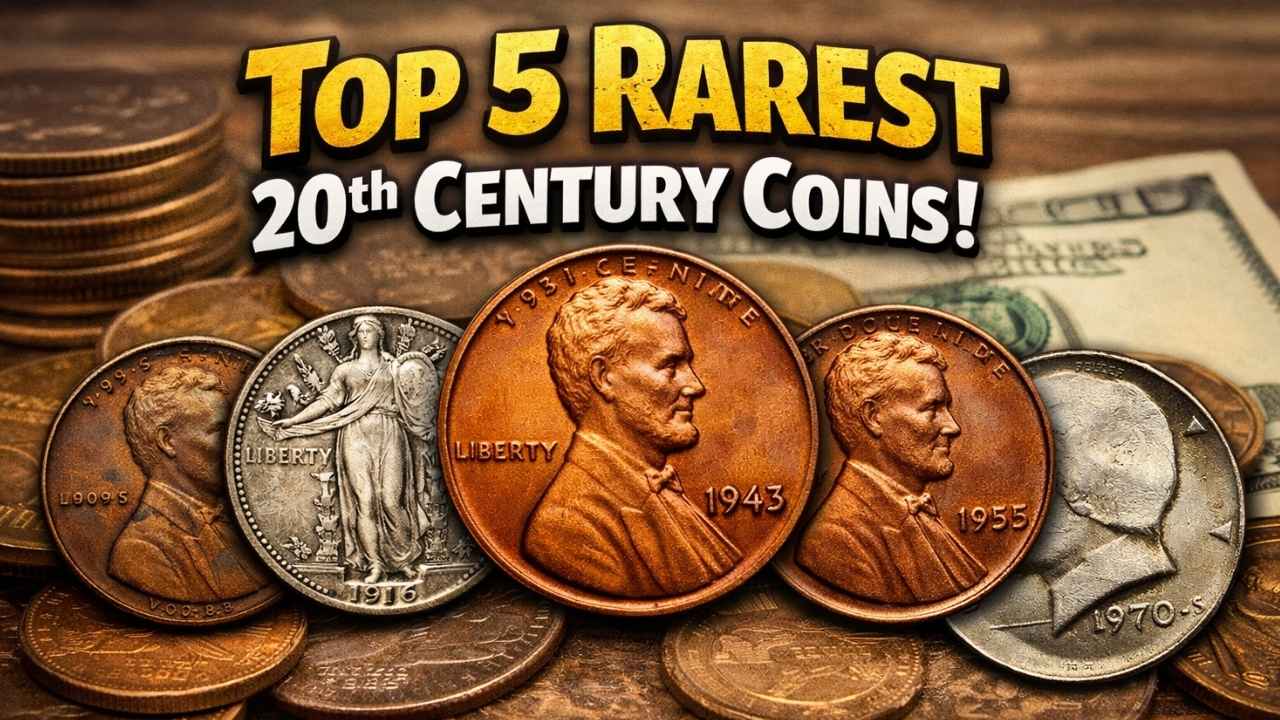
Top 5 Rarest 20th Century Coins: The 20th century produced billions of coins for everyday use, yet a handful of them have become legends in the world of collecting. What once passed casually from hand to hand in grocery stores and gas stations now sits behind museum glass or inside high-security vaults. These coins are not just rare pieces of metal. They are stories of minting mistakes, limited productions, and historical accidents that transformed common currency into multi-million dollar treasures.
From humble pennies to mysterious nickels, the following five coins represent some of the rarest and most valuable creations of the United States Mint between 1900 and 2000. Their journeys from circulation to auction headlines prove that even the smallest denomination can hold astonishing value.

1913 Liberty Head Nickel: The Coin That Was Never Meant to Exist
The 1913 Liberty Head Nickel is one of the most famous rarities in American numismatics. Officially, the Liberty Head design was replaced in 1913 by the Buffalo Nickel. Yet somehow, five Liberty Head nickels bearing the 1913 date were struck.
No official records confirm their authorization. Many experts believe they were produced unofficially by a Mint employee. Regardless of how they came into existence, only five examples are known today.
Each of these nickels has a documented ownership history, passing through the hands of collectors, museums, and investors. When one appears at auction, it commands enormous attention. Over the years, individual specimens have sold for several million dollars, cementing the coin’s reputation as a mysterious and elite treasure.
1909-S VDB Lincoln Cent: The Tiny Initials That Changed Everything
When the Lincoln cent debuted in 1909, it marked the first time a real historical figure appeared on a regular U.S. coin. Designed by Victor David Brenner, the coin featured his initials “VDB” prominently on the reverse.
Public criticism quickly followed, with some arguing that the initials were too bold. The U.S. Mint removed them shortly after production began. In San Francisco, only 484,000 coins with the “S” mint mark and the VDB initials were struck before the change.
That relatively small number makes the 1909-S VDB Lincoln cent one of the key dates in the entire Lincoln series. Even well-worn examples can sell for thousands of dollars, while high-grade specimens command far more. It remains one of the most sought-after pennies ever made.
1943 Copper Penny: A Wartime Mistake Worth a Fortune
During World War II, copper was needed for military equipment. In 1943, the U.S. Mint switched from copper to zinc-coated steel for pennies. These steel cents are common and easy to find.
However, a few copper blanks from 1942 were accidentally left in the presses. As a result, a tiny number of 1943 pennies were struck in copper instead of steel.
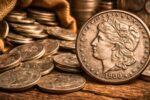
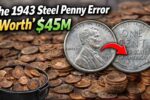
Only a small number of authentic 1943 copper pennies are known today. Because of their dramatic origin story and extreme rarity, they have become one of the most famous error coins in history. When authenticated and in good condition, they can sell for hundreds of thousands or even millions of dollars.
The coin’s legend has inspired generations of collectors to check their spare change carefully, hoping to uncover a life-changing discovery.
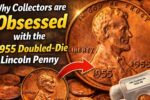
1955 Double-Die Lincoln Cent: The Error You Can See With Your Eyes
Some rare coins require magnification to identify, but the 1955 Double-Die Lincoln cent is different. Its error is bold and obvious.
Due to a misalignment during the die creation process, the date and lettering on the obverse appear clearly doubled. Words like “LIBERTY” and “IN GOD WE TRUST” show dramatic duplication.
Thousands of these coins entered circulation before the mistake was detected. Many were spent and used normally, which is why worn examples still appear today.
Collectors prize this coin because the doubling is so visible and iconic. It is often considered the king of Lincoln cent errors. High-quality examples are especially valuable and continue to attract strong demand.
1969-S Doubled Die Lincoln Cent: A Rare and Controversial Discovery
Another dramatic error emerged in 1969 at the San Francisco Mint. The 1969-S Doubled Die Lincoln cent features significant doubling on the obverse lettering and date.
When the coin first surfaced, some examples were mistakenly seized by authorities who believed they were counterfeits. After expert examination, the coins were confirmed as genuine mint errors.
Fewer than 100 authentic examples are believed to exist. Because of its rarity and early controversy, the 1969-S Doubled Die cent has become one of the most valuable modern-era error coins.
Well-preserved specimens regularly achieve six-figure prices, and its reputation continues to grow among serious collectors.
Why These Coins Matter Beyond Their Price Tags
What makes these coins truly fascinating is not just their value. It is the blend of history, human error, and chance that created them.
Some were struck in secrecy. Others were born from wartime shortages. A few slipped through quality control unnoticed. Each coin reflects a specific moment in American history.
For collectors, these pieces represent the ultimate thrill of the hunt. The idea that a simple penny or nickel could be worth more than a luxury home adds excitement to a hobby built on patience and knowledge.
The Legacy of 20th Century Rarities
The 20th century was a transformative period for U.S. coinage. New designs, shifting materials, and evolving technology shaped the coins Americans carried every day.
Out of billions produced, only a tiny fraction became legendary. The 1913 Liberty Head Nickel, the 1909-S VDB Lincoln cent, the 1943 copper penny, the 1955 Double-Die cent, and the 1969-S Doubled Die cent stand as powerful reminders that rarity can emerge in unexpected ways.
They continue to inspire collectors to examine their change more closely and to learn the stories behind the dates and mint marks. In the world of rare coins, even the smallest cent can hold extraordinary history.
And sometimes, hidden among ordinary coins, there lies a treasure that transforms common metal into a multi-million dollar masterpiece.