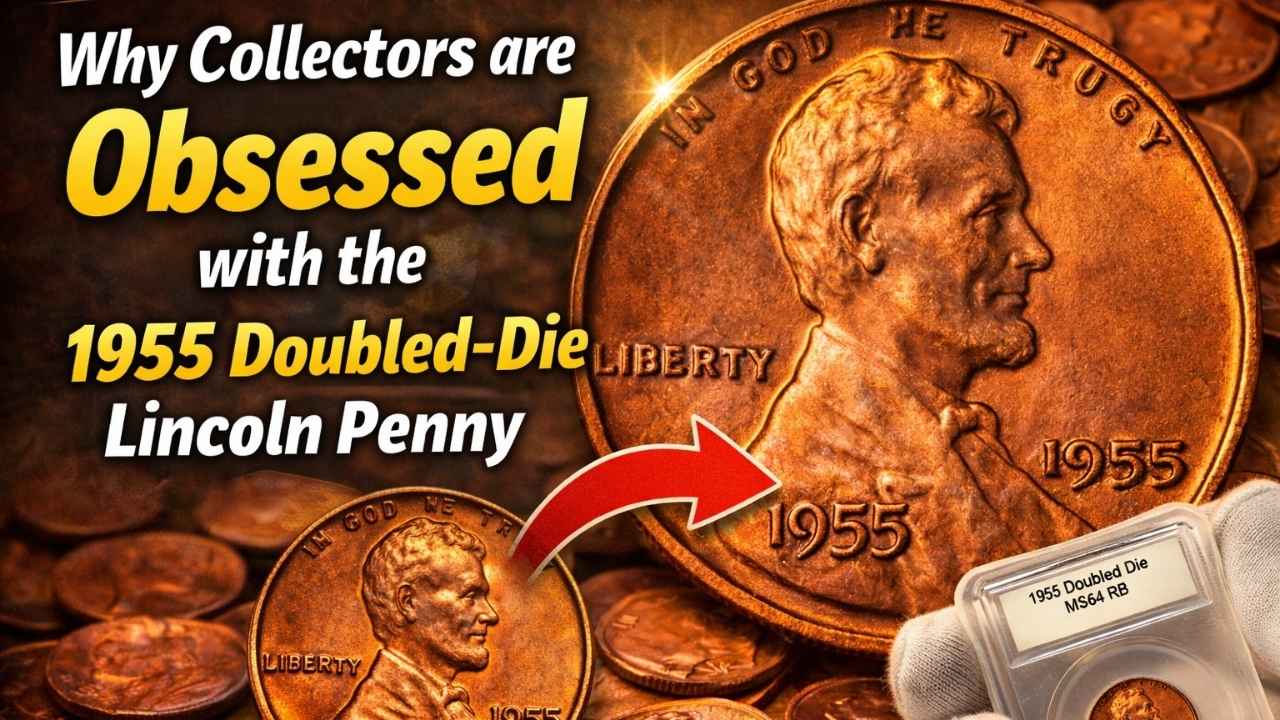
Why Collectors are Obsessed : For American coin collectors, few pieces have sparked as much excitement, debate, and long-lasting fascination as the 1955 Doubled-Die Lincoln Penny. It is not made of gold. It is not ancient. It is not even especially rare compared to some classic 19th-century coins.
Yet it remains one of the most talked-about error coins in history.

Collectors are not just interested in it. They are obsessed.
What Makes It a Doubled-Die?
To understand the obsession, you first have to understand the mistake.
The 1955 Doubled-Die Lincoln Penny was created when the coin’s die received a misaligned second impression during the die-making process. This caused dramatic doubling on the obverse, or front, of the coin.
The doubling is not subtle.
The words LIBERTY, IN GOD WE TRUST, and the date 1955 appear clearly doubled to the naked eye. No magnifying glass is required. Even someone with no collecting experience can see that something looks unusual.
That bold, unmistakable error is part of what makes the coin so famous. Many mint errors require careful study. This one practically announces itself.
A Perfect Storm of Timing
The mid-1950s were a golden era for casual coin collecting in America. Children checked their change. Families saved wheat pennies in jars. The Lincoln cent series, first introduced in 1909, had already become a cultural staple.
When the 1955 Doubled-Die cents entered circulation, they did not go unnoticed for long.
Newspapers reported on the strange pennies. Word spread quickly. Collectors began searching rolls of cents from banks, hoping to find one. Suddenly, a simple one-cent coin became a national treasure hunt.
Unlike many rare coins discovered decades later, this one created excitement almost immediately.
The Thrill of Finding One in Change
Part of the obsession comes from accessibility.
The 1955 Doubled-Die penny was released into circulation. It was not hidden in proof sets or locked away in mint vaults. It passed through grocery stores, gas stations, and vending machines.
Ordinary people found them.
That possibility fuels the imagination. Even today, collectors dream of discovering one in an old jar of wheat pennies or a forgotten coin collection.
The idea that something so valuable once circulated freely makes the coin feel personal and attainable, even if the odds are slim.
Scarcity Without Being Unreachable
Experts estimate that approximately 20,000 to 24,000 examples were released before the error was noticed. Compared to billions of pennies struck that year, that number is tiny.
Yet it is not so rare that only museums can own one.
This balance is crucial. The coin is scarce enough to command strong prices, often ranging from thousands to tens of thousands of dollars depending on condition. At the same time, it is available enough that serious collectors can realistically aspire to own one.
That combination keeps demand high.
Bold Visual Impact
Many error coins require explanation.
The 1955 Doubled-Die does not.
When placed next to a normal 1955 penny, the difference is dramatic. The doubling is strong, clear, and unmistakable. The date looks almost shadowed. The lettering appears thick and duplicated.
It is visually striking.
Collectors love coins that tell their story at a glance. This penny does exactly that. It is easy to show, easy to photograph, and easy to understand.
That visual power has made it one of the most recognizable coins in American numismatics.
A Star of the Lincoln Series
The Lincoln cent series has always been popular. From the 1909-S VDB to key dates like the 1914-D and 1931-S, the series offers challenges for collectors at every level.
The 1955 Doubled-Die stands out within that lineup.
It is not just a key date. It is an error of legendary status. For many Lincoln cent enthusiasts, owning one represents a milestone. It completes a high-level collection. It signals dedication and expertise.
In some ways, it is the crown jewel of mid-20th-century Lincoln cents.
Media Attention and Long-Term Fame
Some coins fade from public attention over time.
The 1955 Doubled-Die never has.
It has been featured in books, magazines, television programs, and online discussions for decades. Auction houses highlight it prominently. Grading services showcase high-quality examples as trophies.
The coin’s fame feeds on itself. New collectors hear about it early in their journey. Seasoned collectors continue to chase better examples.
Its story has become part of collecting folklore.
Condition Matters
Another reason for ongoing obsession is the importance of condition.
Because many examples entered circulation, high-grade coins are far scarcer than lower-grade ones. A well-worn example may still command a strong price, but a sharply struck, lightly circulated or uncirculated specimen can reach significantly higher values.
This creates layers within the market.
Some collectors are content to own any authentic example. Others compete fiercely for coins with blazing luster and minimal marks. Registry sets and grading standards add further competition.
The result is sustained demand across different price levels.
The Educational Value
The 1955 Doubled-Die also serves as a teaching tool.
It helps beginners understand the difference between true doubled-die errors and machine doubling. It introduces the concept of die creation and minting processes. It demonstrates how production mistakes can slip through even in a modern mint.
In classrooms, clubs, and coin shows, the coin is often used to explain error collecting.
That educational role strengthens its legendary status.
A Symbol of the Unexpected
At its heart, the obsession with the 1955 Doubled-Die Lincoln Penny is about more than value.
It represents surprise.
It represents the idea that even in a highly controlled industrial process, something extraordinary can happen. It reminds collectors that the smallest objects can hold the biggest stories.
For many, it was the coin that sparked their passion for the hobby. For others, it remains a lifelong goal.
More than sixty years after its release, it still commands attention, respect, and excitement.
And that is why collectors are not just interested in the 1955 Doubled-Die Lincoln Penny.